Bound the way
it gets used.
Saddle-stitched or coil-bound, collated, stitched and trimmed on one machine. Which binding fits should follow how the book gets used, not the other way around.
Saddle stitch or coil
Both run on the same machine here: the booklet comes off collated, stitched or coiled, and trimmed, in one pass (bindery). Which one to choose comes down to two things — how many pages, and what the book has to do once it is finished.
- Saddle stitch — folded sheets nested inside one another and stapled through the spine. Cheapest, fastest, and it opens close to flat, which is why most magazines, programs and short catalogs are bound this way. Page count has to land in a multiple of four, since every folded sheet carries four pages, and past a certain thickness the spine gets too bulky to lie down.
- Coil — a coil run through drilled holes down the spine, in a color and size you choose. It lies completely flat when open and folds all the way back on itself, which is why manuals, workbooks and calendars get coiled and a magazine usually does not. Coil takes any page count, not only multiples of four, and handles a book too thick for a stitcher.
A third binding comes up in the same conversation: perfect binding, where pages are trimmed flush and glued to a flat spine — the way a paperback is bound. That is not one of the machines on Omega’s own bindery floor, so the real choice here is between saddle stitch and coil. Describe the page count and how the book will be used and we will tell you which one fits.
What actually decides it
Page count rules some of it out before use ever enters the conversation — a thin program is routine either way, a book thick enough to need its own shelf is a coil job before anything else is considered. Past that, the question is what happens to the booklet after it is printed: does it need to lie open on a counter or a workbench while somebody’s hands are busy, which is a coil job, or does it need to look and cost like a magazine, which is a saddle-stitch job? The binding guide has the fuller page-count rules of thumb and where perfect binding sits in the comparison.
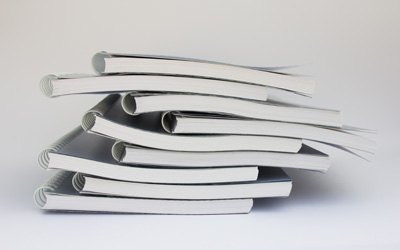
Saddle stitch vs. coil.
Know the page count and how it’ll be used? Send them along and we’ll tell you which binding fits.
Request a quote Call (763) 475-1826Good to
know.
Saddle stitch or coil — which is right for my booklet?
Mostly page count and use. A thin piece that should look and cost like a magazine wants saddle stitch. A thicker book, or one that has to stay open flat on a counter or workbench, wants coil.
Why does a saddle-stitched booklet need a page count in multiples of four?
Each folded sheet carries four pages — two on the front, two on the back — so nesting the sheets and stapling through the fold can only land on a total that goes up in fours. A page count that does not divide by four is usually padded out with a blank or two.
Can a coil-bound booklet really lie flat?
Yes — the coil folds all the way back on itself, which a stapled spine cannot do. That is the reason manuals, workbooks and calendars are usually coiled rather than saddle-stitched.
Do you collate the booklet as part of the job?
Yes — collated, stitched or coiled, and trimmed, on one machine, so the pages do not need to be put in order before they arrive.
Got a booklet
to bind?
Send the page count, trim size and how it’ll be used and we’ll tell you what it costs. Or call (763) 475-1826.