Print a business
actually orders.
Cards, letterhead, envelopes, forms, booklets and mail. Printed offset or digital, folded and bound in the same building, and addressed on the way out if that is where the job is going.
What we print.
Everyday commercial work for businesses of every size — the pieces that go out with a rep, sit on a counter, or land in somebody’s mailbox.
Business cards
Digital or offset, one color to full process, on stock that feels like something.
Letterheads
Matched to your cards and envelopes, printed to run through an office laser without curling.
Envelopes
Printed flat or converted, #10 through catalog, with or without windows.
Letters
Fills, statements and appeals — printed, folded, inserted and mailed in one pass through the shop.
Flyers
One-sheet sell pieces, short-run digital or long-run offset, whichever costs less at your quantity.
Booklets
Saddle-stitched or coil-bound, collated, stitched and trimmed on one machine.
Posters
Full-process color up to 14 × 20 on the Heidelbergs, larger by arrangement.
Notepads
Padded, printed one color or four.
Note cards
Folded or flat, with matching envelopes, scored so they fold clean instead of cracking.
Forms
Business forms, printed and finished here.
Labels
Sheet labels for product, shipping and asset tagging.
Calendars
Wall and desk, stitched or coiled, drilled to hang.
Brochures
Letter, Z, double-parallel and gate folds off the MBO folders — up to four folds in one unit.
Folded, bound
and addressed.
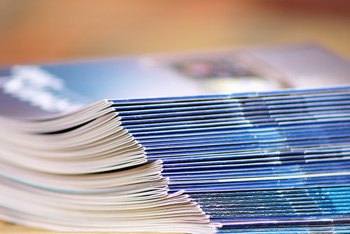
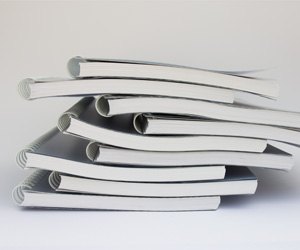
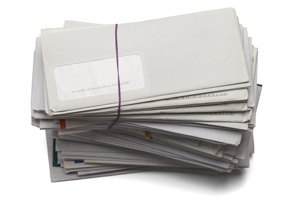
What the list above looks like once it is off the press — collated, folded, bound and, where the job calls for it, carrying an address.
Digital or offset? Quantity decides
Most of these can be printed either way, and the quantity usually settles which. Digital transfers the image straight from the file to the sheet — there is no plate to make, so a hundred pieces is worth running and the cost per piece barely moves. Offset makes a metal plate first. That plate costs the same whether it prints five hundred sheets or fifty thousand, so the longer the run, the less of it each piece carries. Somewhere in the middle the two lines cross, and finding the crossing point for your quantity is most of what a quote is doing.
- Usually digital — short-run business cards, note cards, flyers and booklets, and anything short enough that making a plate would cost more than the printing (digital printing).
- Usually offset — letterheads, envelopes, brochures, posters, forms, and booklets once the quantity climbs. Also anything that has to hold an exact brand color: a spot color is one ink mixed to that color and printed from its own plate, not a build of process dots, so it lands the same every time. Omega runs one to five colors offset, on soy-based inks (offset printing).
What happens after the press
Very little on this list is finished when it comes off a press. Brochures are folded — letter, Z, double parallel, gate. Booklets and calendars are collated and then either saddle-stitched, which is folded sheets nested inside one another and stitched through the spine, or coil-bound. A coil lies flat on a desk, which is why manuals get coiled and catalogs do not. Notepads are padded. Note cards are scored before they are folded, so the coating creases instead of cracking. Calendars are drilled to hang. Forms are collated and padded. All of that happens in the same building as the presses (bindery).
The ones that leave addressed
Letters, flyers, note cards and calendars often go straight from bindery into the mail. Addressing runs in line with wafer-sealing on the ink-jet transport, an inserter puts up to seven pieces into a single envelope, and a bulk presorted mailing — standard or first class — costs less in postage than the same pieces stamped one at a time. If the piece is going to a list, say so when you ask for the price: it changes the paper, the fold and sometimes the size (direct mail).
Before any of it: files and proofs
Every job starts in prepress — layout if you need it, and a proof either way. Proofs come as an emailed PDF or as a hard copy you can hold under a light, and nothing goes to plate until one is approved. Plates are imaged straight from the file, with no film in between (prepress). Artwork already built? Send us the file.
Not on the list? Describe the piece — flat size, finished size, quantity, ink colors, stock and the date you need it — and we will tell you whether it runs here and what it costs.
Good to
know.
Do I need to know whether my job should be offset or digital?
No. Send the quantity, the finished size, the number of ink colors and the stock, and the price comes back for whichever press costs less at that quantity. If the two are close, we will say so.
What is the difference between a spot color and four-color process?
Process builds every color from cyan, magenta, yellow and black dots, which is how photographs print. A spot color is a single ink mixed to that exact color and run from its own plate. Logos and brand colors are usually spot, because a mixed ink lands the same on every job while a build of dots can shift.
How big can you print?
Full-process color up to 14 × 20 inches on the Heidelbergs, and larger by arrangement. See the equipment list for the presses themselves.
Can you print and mail the same job?
Yes. Addressing runs in line with wafer-sealing, an inserter fills an envelope with up to seven pieces, and bulk presorted mail goes out standard or first class (direct mail).
Do you still print business forms?
Yes, forms are everyday work here. Tell us what the form has to do — carbonless sets, sequential numbering, padding — and we will tell you what runs here.
Know what you need
printed?
Send the quantity, size, colors and stock and we’ll price it. Or call (763) 475-1826 and describe the piece — that is often faster.