One to five color,
off a metal plate.
Offset is what a printer runs once the quantity is high enough to earn a plate. The first sheet carries the cost of making ready; the ten-thousandth costs almost nothing.
How offset actually works
The artwork is imaged onto a thin metal plate. On press, the plate is dampened and inked — ink sticks to the image area, water to everything else — and the inked image transfers first to a rubber blanket, and only then from the blanket to the sheet. That indirect step is where the name comes from: the ink is offset onto the blanket before it ever touches paper.
It is not a quirk. A rubber blanket presses into the surface of a sheet in a way a rigid plate cannot, so the image sits down properly on stock that has texture to it, and the plate itself lasts far longer for not being dragged across paper all day.
One color to five
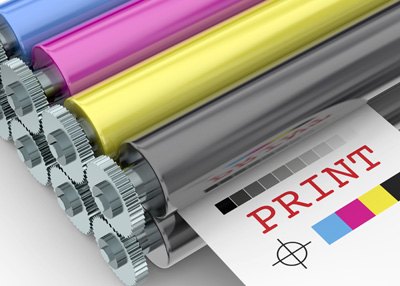
Each color on an offset press is its own unit, with its own plate and its own ink. A one-color job is one plate — black, or a single company color. Four gets you full process. A fifth unit runs a spot color alongside the four process inks, so a brand color can sit exactly right on a page that also carries photographs.
Omega runs one to five color offset. Which end of that a job needs is usually decided by the artwork, not the budget: a black-and-white form and a full-color catalog are different jobs on the same press.
Process color or spot color
These are the two ways to get color onto a sheet, and they are good at different things.
- Four-color process — cyan, magenta, yellow and black, laid down as fine dot patterns that the eye mixes into every other color. It is how photographs get printed, and it is the right answer for brochures, posters, postcards and anything with an image in it.
- Spot color — a single ink, mixed to a formula before it goes in the fountain and laid down solid. Nothing is being simulated, so the color is the same this run as it was last run. That is what a company identity and a logo want.
Cost follows the number of units, not the amount of ink. A two-color job in two spot colors uses two plates and two units; the same job in process uses four of each. For a letterhead, a form or a two-color identity piece, spot is usually both better looking and cheaper. For a photograph, there is no substitute for process.
The presses
Three Heidelberg 14 × 20 sheet-fed presses do most of the work: a GTOF five color, a GTOVP four color perfector and a GTOVP two color perfector. Alongside them, a Sakurai two color 28″, two Ryobi 11 × 17s (one two color, one single color) and a pair of AB Dick envelope feeders for work that prints on the envelope itself.
A perfector is worth understanding before you price a two-sided job. An ordinary press prints one side of the sheet; the stack then has to dry, be turned, and be made ready all over again for the back. A perfector turns the sheet inside the press and prints both sides in one pass. One pass, one make-ready, no drying wait in the middle — which is exactly why a two-sided job does not simply cost twice a one-sided one.

Soy-based inks and plates that go back on the press
Omega uses only environmentally friendly soy-based inks. And the plates are metal, so they can be reused rather than thrown away — unlike printers running disposable paper or plastic plates, where every job's plates are consumed and billed.
Both of those are quiet, practical things rather than a campaign. Reusable plates keep material cost and material waste down at the same time, which is the only kind of environmental claim worth printing.
When offset beats digital, and when it does not
The honest answer is that it depends on three things, and quantity is only the first of them.
- Quantity. Offset carries a fixed cost up front — plates and make-ready — and then a very low cost per sheet. Digital carries almost no set-up and a flat cost per sheet. Plot both and they cross. Below the crossover, digital wins; above it, offset wins, and it keeps winning by more the longer the run gets.
- Spot color. A toner press builds every color out of its four process toners. If a brand color has to be exact, it wants a spot ink on an offset unit.
- Stock. Offset takes a wider range of paper than a toner press will feed and fuse — heavier, more textured, more unusual.
If the run is short and the color is ordinary, say so and we will point you at digital printing instead. Whatever the job runs on, the finishing happens in the same building — see bindery for folding, stitching, coiling and cutting.
Not sure which side of the crossover you are on? Send the quantity, the flat size, the number of colors and the stock you have in mind, and we will quote it. The quantity where offset overtakes digital moves with every one of those.
Printed on the Heidelbergs
One to five units
One color, full four-color process, or process plus a fifth unit for a spot.
Spot color, held
A brand color mixed as ink and laid down solid — not approximated out of dots.
Two perfecting presses
Both sides of the sheet in one pass: one make-ready instead of two.
Soy inks, reusable plates
Soy-based inks only, on metal plates that go back on the press instead of in the bin.
Good to
know.
What is the difference between offset and digital printing?
Offset images a metal plate and prints through a rubber blanket onto the sheet; digital puts toner straight on the paper with no plate at all. Offset costs more to start and far less per sheet, so it wins on longer runs, on exact spot colors and on a wider range of stock. Digital printing wins on short runs and on speed.
How many colors can you print?
One to five. One color is a single ink — black or a company color. Four is full process. The fifth unit lets a spot color run alongside the four process inks on the same pass, which is how a logo holds its exact color on a page that also has photographs on it.
Can you match our exact brand color?
That is what spot color is for. A spot ink is mixed to a formula and printed solid, so it comes out the same this run as last run. Send the Pantone number rather than a CMYK approximation of it, and say on the file which elements are meant to be spot.
What is a perfector, and why does it matter to my price?
A perfector turns the sheet inside the press and prints both sides in one pass. Two of the three Heidelberg 14 × 20s are perfectors. A two-sided job on a perfector needs one make-ready rather than two and does not have to wait for the first side to dry, which is why the back of a sheet does not cost the same as the front.
What sheet size do the presses run?
The three Heidelbergs are 14 × 20 presses, the Sakurai is a 28″ two color, and the two Ryobis run 11 × 17. Trim size, number-up and the fold pattern all follow from which sheet a job runs on, so it is worth telling us the finished size early.
Got a job to price?
Send us the specs and we'll quote it. Or call (763) 475-1826 and talk it through with someone who runs the presses.