What’s in the
building.
Prepress, presses, bindery and mailing — the whole list, in the order a job moves through the shop. If you are checking whether your piece can run here, this is the page that answers it.
How to read a press list
A list of machines looks like trivia until you are pricing a job, at which point it is the whole answer. The press a job runs on decides what it costs; the machines behind the press decide how many times it has to be picked up, boxed, driven somewhere and unpacked again. Both of those end up on the invoice.
The numbers worth knowing
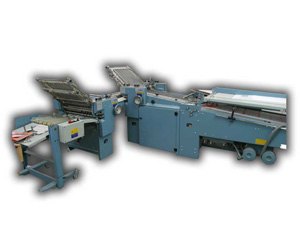
- The MBO folder runs up to 35,000 pieces an hour and takes up to four folds in a unit — straight, parallel, double parallel, letter, Z and more.
- The Muller Martini Minuteman saddle stitcher collates, stitches and trims in one pass, at up to 7,000 books an hour.
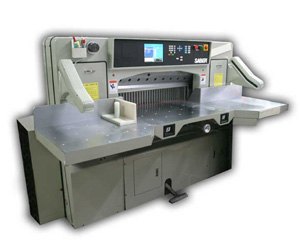
- The 37″ Saber cutter takes more than 1,000 sheets in a single slice and is programmed cut to cut, so the operator is not resetting the back gauge by hand between them.
- The Cheshire Model 7000 ink-jet transport wafer-seals in line with addressing, rather than as a second handling.
- The Bell & Howell inserter puts up to seven pieces into one envelope.
Those five are the reason a booklet or a mailing does not need a second vendor part way through — see bindery and direct mail.
Why the small presses are on the list too
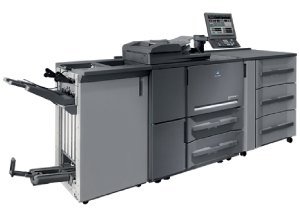
The 11 × 17 Ryobis and the envelope feeders are there so a one- or two-color job on a small sheet does not have to tie up a five-color press: less make-ready, less waste, less cost. The two Konica Minolta digital presses print with no plate at all, which is what makes a run of a hundred worth doing (digital printing). And the plates the offset presses do use are metal, and get reused rather than thrown out (offset printing).
Three things the
list is telling you.
Five colors, and both sides
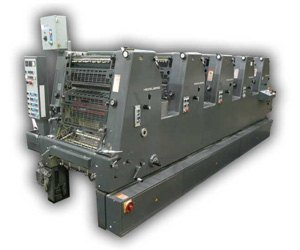
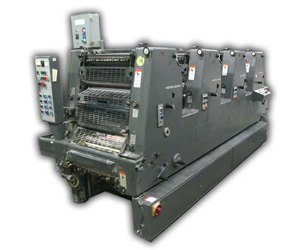
A five-color press lays four process colors plus a fifth — a spot ink — in one pass, in register. A perfector turns the sheet inside the press and prints the back on the same pass. Two of the three Heidelberg offset presses are perfectors, so two-sided work does not go through twice.
Direct to plate, no film
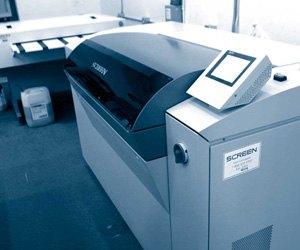
Plates are imaged straight from the file on the Screen platesetter running Trueflow. No film to shoot, strip or store — one less generation between your artwork and the plate, and one less place for a fault to appear.
Finishing under the same roof
Folders, a saddle stitcher, coil binders, drills and two programmable cutters sit on the same floor as the presses. The job does not leave the building to be finished, so there is one schedule to keep instead of two.
The full list.
Five groups, in the order a job passes through them — prepress, press, bindery, mail.
Electronic prepress
- Screen Trueflow workstation
- Trueflow server
- Adobe CS4 & QuarkXPress 8, PC and Mac
- High-resolution image scanning
- Dell PowerEdge server
- Epson 9600 printer
- Screen PlateRite 4100 direct-to-plate
- Sword Excel NE34 processor
Sheet-fed offset
- Heidelberg 14 × 20 GTOF five color
- Heidelberg 14 × 20 GTOVP four color perfector
- Heidelberg 14 × 20 GTOVP two color perfector
- Sakurai two color 28″
- Ryobi 11 × 17 two color
- Ryobi 11 × 17 one color
- AB Dick 1200 envelope feeder (2)
Digital
- Konica Minolta C7000 digital color
- Konica Minolta 1052 digital black and white
Bindery
- MBO B18 with right-angle folder
- MBO B21C with right-angle folder
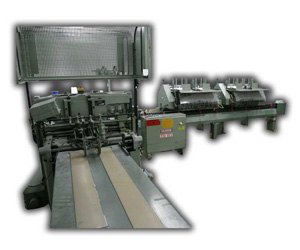
- Muller Martini Minuteman saddle stitcher
- Heidelberg Windmill
- Roscoe three-hole drill
- Challenge three-hole hydraulic drill
- Clamco shrink wrap
- EPK 21 electronic GBC (2)
- Rosback 106 saddle stitcher
- 32″ ProCut paper cutter with microprocessor
- 37″ Saber paper cutter with microprocessor
- GBC binding
- Unibind
- ALS 9000 wafer seal
- Coilmac EPI41
- Coil binders (2)
Mailing
- Cheshire Model 7000 ink-jet transport, wafer-sealing in line with addressing
- Bell & Howell inserter — up to seven pieces per envelope
Got a job for one
of these presses?
Send the specs and we’ll tell you what it runs on and what it costs. Or call (763) 475-1826 and talk it through with someone who runs them.