Short color runs,
straight from the file.
A digital press puts the image straight onto paper from the computer. No plate, no make-ready — which is what makes a short color run affordable, and quick.
Near press quality, a fraction of the cost
Digital presses give near press quality at a fraction of the cost of setting up an offset run. Because the image goes directly from computer to paper, there is no plate to image and no press to make ready, so a short color run is genuinely cost effective rather than merely possible — and delivery is faster for the same reason.
Everything that gets skipped is set-up. That is the whole of the advantage, and it is a real one: on a run of two hundred, set-up is most of the bill.
The two machines
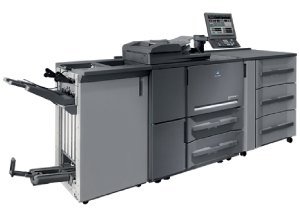
- Konica Minolta C7000 — digital color.
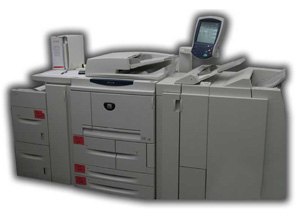
- Konica Minolta 1052 — digital black and white.
A separate black-and-white device is not redundancy. Manuals, forms, book blocks and long text documents are cheaper per page on a machine built only to print black, and they run at a different speed. Sending a 400-page manual through a color press because it has one color logo on the cover is how a straightforward job gets expensive.
Catalogs that come off finished
Catalogs can come off the machines collated, folded, stapled and with tabs inserted, ready to go out the door. Every one of those steps is a handling step that does not have to happen twice: the sheets are not stacked, moved, counted and fed into something else, they simply come out as books.
Larger books, coil binding, drilling and trimming go through the bindery the same way an offset job does.
The trade-off against offset, stated honestly
Digital is not simply better than offset, and anyone who tells you otherwise is selling one machine. What each is good at:
- Cost curve. Digital costs about the same per sheet whether you print fifty or five thousand. Offset costs a lot for the first sheet and very little for the ones after it. There is a crossover quantity, and past it offset is cheaper — increasingly so.
- Spot color. A toner press builds every color from its own four toners. An exact brand color wants a spot ink on an offset unit.
- Stock. Toner has to be fused to the sheet with heat, which puts a practical limit on how heavy and how textured a stock can be. Offset's range is wider.
- Solids. Large flat areas of color are where the difference between toner and ink shows up first. Small type, line work and photographs generally do not show it at all.
Where digital is the right answer
- Short color runs — the case it was built for.
- Work that has to be in someone's hands quickly.
- A piece that will change again soon. Nothing is committed to a plate, so the next version costs no more than this one.
- Reprints of a small quantity, where re-plating an offset job cannot be justified.
- Long black-and-white documents on the 1052.
The crossover is not a fixed number — it moves with sheet size, color count, stock and how much make-ready the offset version would need. Send the specs and we will price it both ways.
What the digital presses do well
No plate, no make-ready
The image goes from computer to paper, so a short run is not paying for set-up.
Faster delivery
Fewer steps between an approved file and a finished stack.
Finished on the machine
Catalogs come off collated, folded, stapled and with tabs inserted.
Color and black-and-white
A C7000 for color, a 1052 for the long black-only work that would waste it.
Good to
know.
How short is a short run?
There is no single number, and anyone quoting one is guessing. The quantity where offset overtakes digital moves with the sheet size, the number of colors, the stock and how much make-ready the offset job needs. Send us the specs and we will price it both ways so you can see where yours falls.
Will a digital reprint match the offset original?
Close, but the two build color differently — toner against ink, and process against spot. If exact color match to an earlier run matters, say so with the job, and expect the answer to be that a piece with a critical brand color is better reprinted the way it was printed the first time.
Is digital printing lower quality than offset?
It is near press quality. Where you will see a difference is in large flat solids and in an exact spot color, not in resolution or in small type. On a lot of everyday commercial work there is nothing in it, which is exactly why the crossover is a question about quantity rather than about quality.
Can a booklet come off the digital press finished?
Catalogs can come off collated, folded, stapled and with tabs inserted, ready to go out the door. Anything beyond that — coil binding, drilling, trimming to an unusual size — goes through the bindery.
Do you print black-and-white work as well as color?
Yes — on the Konica Minolta 1052, which prints black only. For manuals, forms and long text documents that is the cheaper machine per page, and there is no reason to run them through a color press.
Got a job to price?
Send us the specs and we'll quote it. Or call (763) 475-1826 and talk it through with someone who runs the presses.