Printed, addressed,
sorted and dropped.
Direct mail reaches the areas you target and the demographics you pick. The useful part is that the piece never leaves the building until it goes to the post office.
One building, one hand-off
A mailing normally passes between two companies: a printer prints it, then it is counted, boxed, shipped and re-counted at a mail house that addresses and sorts it. Every one of those hand-offs is a shipment, a count to reconcile and somebody else's schedule.
Here the sheets come off the press, go through the bindery to be folded, get addressed and sealed on the Cheshire, get inserted if there is an envelope, get presorted, and go to the post office. Same building, one set of hands, one count.
Addressing and sealing
Omega runs a Cheshire Model 7000 ink-jet transport, which prints the address directly onto the piece as it travels through — and wafer-seals in line with addressing.
"In line" is the part worth noticing. On most equipment, addressing and tabbing are two separate passes: the whole job runs through once to be addressed, is stacked, and runs through again to be sealed. Doing both in one pass halves the handling on every folded self-mailer.
Inserting
A Bell & Howell inserter puts up to seven pieces of material into a single envelope. A fairly demanding mailing — a letter, a reply card, a reply envelope, a buckslip and a brochure — is five, so seven is headroom rather than a limit you will be arguing with.
If you have been stuffing, labeling and stamping mailings by hand around a conference table, this is the machine that stops that.
What presort is, and why the postage drops
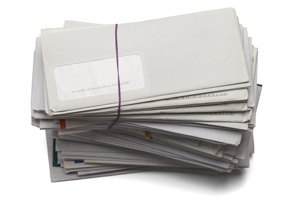
Postage is priced by how much work the Postal Service has to do. A single stamped letter arrives having had nothing done to it: it has to be faced, read, sorted, and routed down to a carrier. A presorted mailing arrives with part of that already done — pieces sorted into ZIP code sequence, grouped down to the carrier route where the volume supports it, bundled and trayed, with the paperwork that documents the sort. The Postal Service skips steps, and the rate drops to match.
That is the whole trick, and it is why bulk presorted postage runs well below the single-piece rate. On a mailing of any size the postage is usually larger than the printing, so it is the number worth optimizing first.
Omega handles bulk presorted mailings in both classes:
- Standard — bulk marketing mail. The cheapest way to send a large mailing. It travels more slowly and on a less predictable schedule, and it is not forwarded or returned unless you ask for it. Right for anything that is not date-critical.
- First class — faster and more predictable, forwarded when a recipient has moved and returned when an address is dead. That return is worth paying for at least once, because it is how a mailing list gets cleaned.
Both have minimum piece counts set by the Postal Service, not by us — a bulk standard mailing starts at 200 pieces (or 50 pounds), presorted first class at 500. Below that, stamps.
One thing worth knowing before the list is finalized: the rate depends on the addresses being complete and standardized. A poorly formatted list gets a worse sort, and every undeliverable piece is postage spent twice.
What gets mailed
Postcards, letters, statements, appeals, newsletters, catalogs, and multi-piece stuffed envelopes. All of them are printed here first — see products for what that covers, and offset or digital for which press a given quantity wants.
From press to post office
Addressed in line
A Cheshire Model 7000 addresses and wafer-seals in a single pass, not two.
Up to seven pieces
A Bell & Howell inserter fills one envelope with up to seven pieces.
Presorted rates
Bulk presorted, standard and first class — postage well below the single-piece rate.
Printed here as well
Printed, folded, addressed, sorted and dropped without leaving the building.
Good to
know.
What is presorted mail, and why is it cheaper?
Presorted mail arrives at the Postal Service with some of the sorting already done — pieces in ZIP code sequence, grouped to carrier route where the volume allows, bundled and trayed with the documentation for the sort. That is work the Postal Service does not have to repeat, so the rate is lower. Postage is usually the biggest line on a mailing, which makes it the first number worth improving.
Should I mail standard or first class?
Standard, or bulk marketing mail, costs less and travels slower, and it is not forwarded or returned unless you ask for it. First class is faster and more predictable, gets forwarded when someone has moved and comes back when an address is dead. If the piece has a date on it, first class. If you are cleaning a list, first class at least once.
How many pieces do I need for a bulk mailing?
The Postal Service sets the thresholds: a bulk standard mailing starts at 200 pieces or 50 pounds, and presorted first class at 500 pieces. Under that, it goes at the single-piece rate. Send us the count and we will tell you which rate the job falls into.
Can you put several pieces into one envelope?
Up to seven, on the Bell & Howell inserter. A letter, a reply card, a reply envelope, a buckslip and a brochure comes to five, so most multi-piece mailings sit comfortably inside that.
Do I need to tab a folded mailer?
Yes — the Postal Service requires folded mail sent without an envelope to be sealed shut. That is what a wafer seal is, and on the Cheshire it happens in line with the addressing rather than as a second pass through the shop.
Got a job to price?
Send us the specs and we'll quote it. Or call (763) 475-1826 and talk it through with someone who runs the presses.