Folded, stitched,
coiled and trimmed.
Bindery is everything that happens to a sheet after it leaves the press — the difference between a printed job and a stack of paper.
Omega handles bindery for its own work, from a simple letter-fold brochure to a hand-finished pocket folder. Four machines do most of it.
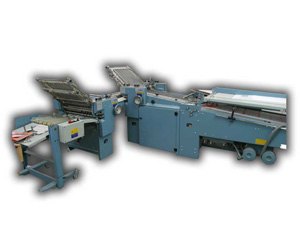
Folder
An MBO B21C with a right-angle unit, continuous feed and an eight-page unit. It runs at up to 35,000 pieces per hour and folds up to four folds per unit — straight, parallel, double parallel, letter, Z fold and more.
What those names mean, since they decide how a piece opens:
- Letter fold — two parallel folds, panels tucking inside one another. The standard rack brochure. The tucked panel is made slightly narrower so it does not buckle.
- Z fold — two folds in opposite directions, so it opens out like an accordion. Every panel is the same width and every panel is visible as it opens.
- Double parallel — folded in half, then in half again the same way. Eight panels from one sheet, and a compact piece that opens big.
- Right angle — a second fold at 90° to the first. That is how a flat sheet becomes a folded booklet or a French fold rather than a longer and longer strip.
Panel widths are not a detail to leave until the folding stage. They are set in prepress, before plates.
Stitcher
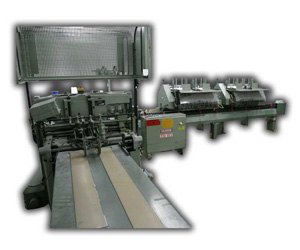
A Muller Martini Minuteman saddle stitcher, which collates, stitches and trims books in one pass at up to 7,000 books per hour, across a range of trim sizes.
Saddle stitching is the binding most catalogs, programs and booklets use: folded sheets are nested inside one another over a saddle, stapled through the spine fold and trimmed on three sides. It is the cheapest way to bind a book, it opens close to flat, and it has two rules worth knowing before you lay a job out. Page count must be a multiple of four, because each folded sheet carries four pages. And past a certain thickness the inner sheets push out far enough that trimming takes visible width off their outer margins — which is a prepress adjustment, not a bindery problem, provided somebody thinks of it early.
Coiler
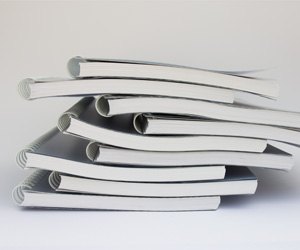
Coil binding is the alternative when a saddle stitch is not what the piece wants, and the color and size of the coil are yours to choose.
The reason to reach for it is mechanical: a coil-bound book lies flat, and folds all the way back on itself. That is why manuals, workbooks, cookbooks and wall calendars get coiled and catalogs do not — anything that has to stay open on a bench while somebody's hands are busy. Coil also takes any page count rather than multiples of four, and handles a thickness that would defeat a stitcher. What it gives up is a printed spine.
GBC plastic comb and Unibind thermal binding are in the bindery too, for the jobs that suit them — comb because pages can be taken out and put back later, thermal because it finishes like a perfect-bound book with a flat printed spine.
Cutter
A computer-programmable 37″ Saber cutter with a microprocessor system. It cuts through more than 1,000 sheets of paper in a single slice, and the microprocessor moves the back gauge from cut to cut without the operator setting each one by hand — which is faster and, more to the point, identical every time. A 32″ ProCut runs alongside it.
Almost every job touches a cutter twice: once to cut the parent sheets down before printing, and once to trim the finished piece to size.
Drilling, padding, sealing, wrapping
- Drilling — three-hole drilling for ring binders, on a Roscoe drill and a Challenge hydraulic drill.
- Padding — notepads padded in-house, to the sheet count you need.
- Wafer sealing — an ALS 9000. A wafer seal is the small clear tab that holds a folded self-mailer shut; the Postal Service requires folded mail to be tabbed, and this is how it gets done. On a mailing it can happen in line with the addressing instead — see direct mail.
- Shrink wrapping — a Clamco, for counting into bundles that arrive as bundles.
- Scoring and perforating — a score is a crease pressed into heavy stock so it folds cleanly instead of cracking the coating along the fold; any cover weight wants one. A perforation is a line of small cuts so a reply card or a coupon tears off straight instead of ragged. Both are platen work, on the Heidelberg Windmill.
Which binding for which job
- Saddle stitch — cheapest, fastest, opens nearly flat. Multiples of four pages. Best up to the point where the folded spine gets too thick to lie down, which depends on the stock as much as the page count.
- Coil — lies dead flat and folds back on itself. Any page count, thick books included. No printable spine.
- GBC comb — pages can be added or removed after binding.
- Unibind — thermal, with a flat printed spine, for something that should look like a book on a shelf.
Not sure which the piece wants? Most of the answer is in what it is for. The products page lists what usually gets bound which way.
In the bindery
Folding
Up to four folds per unit at up to 35,000 pieces per hour — straight, letter, Z and more.
Saddle stitching
Collated, stitched and trimmed in one pass, up to 7,000 books per hour.
Coil, comb and thermal
Coil when the book has to lie flat; comb and Unibind when it should not be stapled.
Programmable cutting
A 37″ Saber that takes more than 1,000 sheets in a single slice, cut to cut.
Good to
know.
Why does a saddle-stitched booklet have to be a multiple of four pages?
Because each folded sheet makes four pages — two on the front, two on the back. Nest the sheets, staple through the fold, and the total can only ever go up in fours. If your content lands on 14 pages, the book is 16 with two blanks, so it is usually worth deciding early where those blanks are useful.
Saddle stitch or coil binding?
Saddle stitch is cheaper and looks like a magazine, but it needs page counts in fours and gets unhappy once the spine is thick. Coil lies completely flat and folds back on itself, takes any page count and handles thick books — which is why manuals, workbooks and calendars are coiled. Coil cannot carry a printed spine.
What folds can you do?
Straight, parallel, double parallel, letter and Z folds among others, up to four folds per unit, with a right-angle unit for folds at 90° to the first. Tell us the finished size and how it should open, and the panel widths get worked out in prepress.
Can you drill holes so it fits a ring binder?
Yes — three-hole drilling, on either of the two drills in the bindery. Leave enough margin on the binding edge in the artwork so the holes do not land in the type.
What is a wafer seal, and do I need one?
It is the small clear tab that holds a folded self-mailer closed. If a piece is folded and mailed without an envelope, the Postal Service requires it to be tabbed, so yes. On a mailing the sealing runs in line with the addressing rather than as a separate pass.
Got a job to price?
Send us the specs and we'll quote it. Or call (763) 475-1826 and talk it through with someone who runs the presses.